
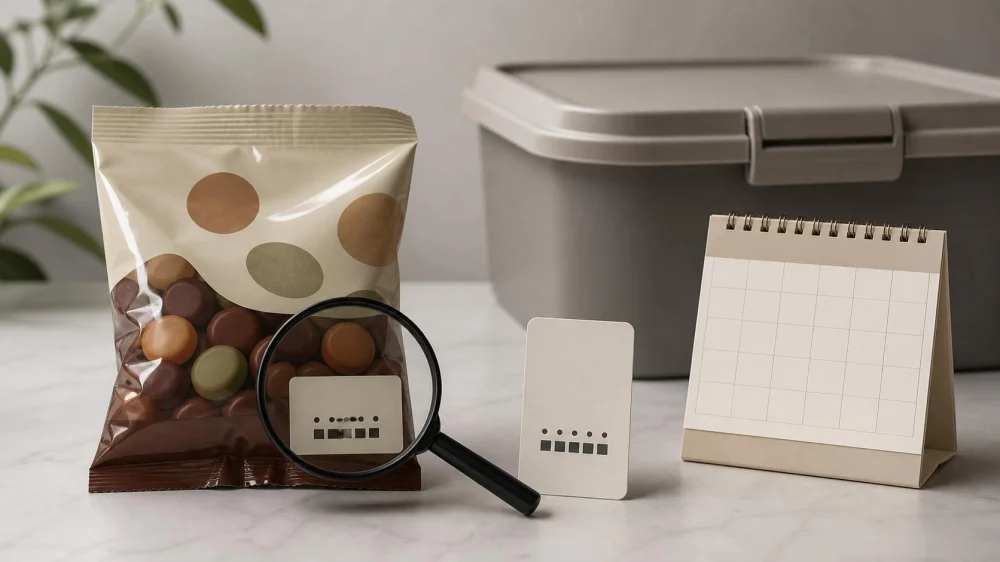
Candy Recall Check: Match Brand, Lot, Size, and Date
On this page
- Quick answer
- Identify the exact package
- Use the official notice
- Match every recall field
- Follow the stated action
- Handle possible illness or allergy
- Check candy throughout the household
- Preserve useful records
- Candy recall checklist
- Frequently asked questions
- Sources and evidence notes
- Conclusion and next steps
Quick answer
A candy recall rarely applies to every package with a familiar brand name. Compare the physical package with the official recall notice field by field: exact product and flavor, package size and type, UPC, lot or batch code, best-by or use-by date, and distribution area. Product photos can help, but codes and written details make the identification.
If the package matches, follow the notice’s instructions to discard, return, or otherwise handle it. Do not eat it, serve it, donate it, or give it to a pet. If you cannot tell whether it matches, set it aside where no one can consume it and contact the manufacturer or retailer using verified recall information.

Chutters / chutters littleton nh
LittletonGrafton CountyNew Hampshire
43 Main St, Littleton, NH 03561, USA
Identify the exact package
Keep the original wrapper, bag, box, tub, or assortment carton. Look on seams, the back panel, bottom, crimp, neck, and near the Nutrition Facts label for printed or stamped codes. A lot code may combine letters and numbers; a best-by date is not always the lot code. Photograph all sides before the package is discarded or returned.
For a variety pack, determine whether the recall identifies the outer box, an inner candy, or both. For individually wrapped pieces removed from their carton, identification may be impossible if the lot code was only on the outer package. Do not rely on wrapper color, candy shape, or memory of the purchase date.

MarieBelle / mariebelle chocolate
New YorkNew York CountyNew York
484 Broome St, New York, NY 10013, USA
Use the official notice
Start with FDA’s Recalls, Market Withdrawals, and Safety Alerts page for FDA-regulated food, then open the specific company announcement. A retailer, state agency, or manufacturer may also publish instructions. Check the posting date and look for an update or expansion because recall scope can change.
FDA notes that its public safety-alert page contains certain recall notices and is not the complete record of every recall. Its Enforcement Reports provide additional searchable recall information. Avoid treating a social-media screenshot or forwarded message as the final source; use it only as a prompt to find the current official notice.
Match every recall field
- Brand and product: include line, flavor, filling, and variety.
- Package: compare bag, box, jar, count, and net weight.
- UPC: match the full number, not only the first digits.
- Lot or batch: preserve leading zeroes, letters, spaces, and punctuation.
- Date: check best-by, use-by, sell-by, or production dates exactly as described.
- Distribution: compare states, stores, online channels, or institutions.
- Images: use photos to locate codes and confirm packaging, not to replace code matching.
A difference in size, code, or date may place a package outside a narrowly defined recall. When the notice says “all lots” or gives a broad date range, apply that broader scope exactly.
Follow the stated action
The recall notice may direct consumers to discard the candy, return it for a refund, or contact the company. Follow those directions and local waste requirements. Make the product unusable and inaccessible to children, other household members, pets, and wildlife while awaiting disposal.
Do not open a sealed recalled product to inspect, smell, or taste it. Contamination, undeclared allergens, foreign material, or a packaging defect may not be visible. Cleaning needs depend on the hazard: if candy leaked or contacted a surface, ask the company or public-health authority for instructions rather than applying a generic food-cleaning rule.
Handle possible illness or allergy
If someone ate recalled candy, the next step depends on the stated hazard, amount, timing, symptoms, and individual risk. Read the notice for named symptoms and contact a healthcare professional or poison center as appropriate. Call 911 for trouble breathing, throat swelling, collapse, severe confusion, or other life-threatening symptoms.
Do not wait for a visible defect and do not induce vomiting unless a qualified professional instructs it. For a possible allergic reaction, follow the person’s emergency plan and use prescribed epinephrine as directed. Keep the package and recall notice available for responders.
Check candy throughout the household
Recalled candy may be in a pantry, desk, backpack, vehicle, gift basket, party favor, freezer, workplace bowl, or holiday storage box. Search by the exact product description and retrieve packages before sending a group message. Tell household members why the item is isolated and what action the notice requires.
For a candy dish, bulk jar, or mixed treat bag, trace pieces back to their original package. If a recalled item cannot be reliably separated from unlabeled pieces, contact the manufacturer or local health department for disposal guidance. Review online order history and receipts when the package is gone.
Preserve useful records
Photograph the product, front and back labels, ingredient statement, UPC, lot code, date, and any damage. Save the receipt, order confirmation, store and purchase date, quantity, storage history, and any symptoms. If the company asks for a sample, do not mail or transport it until it provides safe instructions.
Record the contact channel, case number, date, and instructions received. Report problems through the route named in the notice or FDA consumer guidance. Keep medical records and expenses if illness occurred, but do not delay care while assembling documentation.
Candy recall checklist
- Set the suspected package aside unopened.
- Open the current official recall notice.
- Check for updates or expanded scope.
- Match product, flavor, size, and package type.
- Match UPC, lot code, and date character by character.
- Confirm distribution area and sales channel.
- Follow the specified return or disposal action.
- Search pantry, gifts, vehicles, desks, and order history.
- Save package photos, receipt, and contact records.
- Seek prompt medical help for concerning symptoms.
Frequently asked questions
Does a recalled brand mean every candy from that company is unsafe?
Not usually. Use the exact scope in the official notice, which may name specific products and lots.
Is the best-by date the same as the lot code?
Not necessarily. The notice should explain which codes identify affected packages and where to find them.
Can I taste the candy to see whether it is bad?
No. A recalled product may look, smell, and taste normal.
What if my package is missing its outer box?
Set it aside and contact the company. Do not guess when required identifiers were on the missing carton.
Can I donate a matching unopened package?
No. Follow the recall’s return or disposal instructions.
What if an online post conflicts with FDA?
Use the latest official notice and manufacturer update, and call the listed contact if the scope remains unclear.
Sources and evidence notes
The U.S. Food and Drug Administration’s Food Recalls: What You Need to Know explains that notices can identify products by name, packaging, UPC, lot or date codes, images, and distribution information. FDA’s Recalls, Market Withdrawals, and Safety Alerts page publishes current notices and links to archived and additional recall information.
Recall instructions are hazard- and product-specific. The current official notice and healthcare advice take priority over this general identification workflow.
Conclusion and next steps
When a candy recall appears, isolate first and identify precisely. Match every field on the physical package to the latest official notice, follow its stated action, search other storage locations, and preserve records. If exposure or symptoms are involved, put medical care ahead of refund or reporting steps.





 Idyllwild Soda Pop & Sweet Shop4.0 (17 reviews)
 Wappos Munchies0.0 (0 reviews)
 Chocolat Michel Cluizel, Store & Chocolate Tours4.0 (112 reviews)
 Reppert's Candy4.0 (410 reviews)
 Candy World3.0 (54 reviews)
 JOY Chocolate Co4.0 (31 reviews)
 Top Candy Shops for Tourists in New York – Best Sweets and Treats
 Best Candy Shops in New York - A Sweet Adventure Through the City
 How to Make Candy-Themed Crafts for Christmas Gift Giving
 How to Make Chocolate-Covered Strawberries for Kids: A Fun and Easy Recipe
 How to Make Easy Gummy Worms at Home | Homemade Candy Recipes
 How to Host a Candy-Themed Movie Night | Fun and Sweet Ideas