
Nougat Candy Guide: Whipped, Chewy, Nutty, or Layered
On this page
- Quick answer
- What nougat means
- White or whipped nougat
- Caramelized or brittle-style nougat
- Soft, chewy, firm, and crisp textures
- Nuts, fruit, seeds, and flavoring
- Layered bars and chocolate-coated nougat
- Check freshness and storage
- Read allergens and dietary labels
- Taste nougat by texture and balance
- Frequently asked questions
- Sources and evidence notes
- Conclusion and next steps
Quick answer
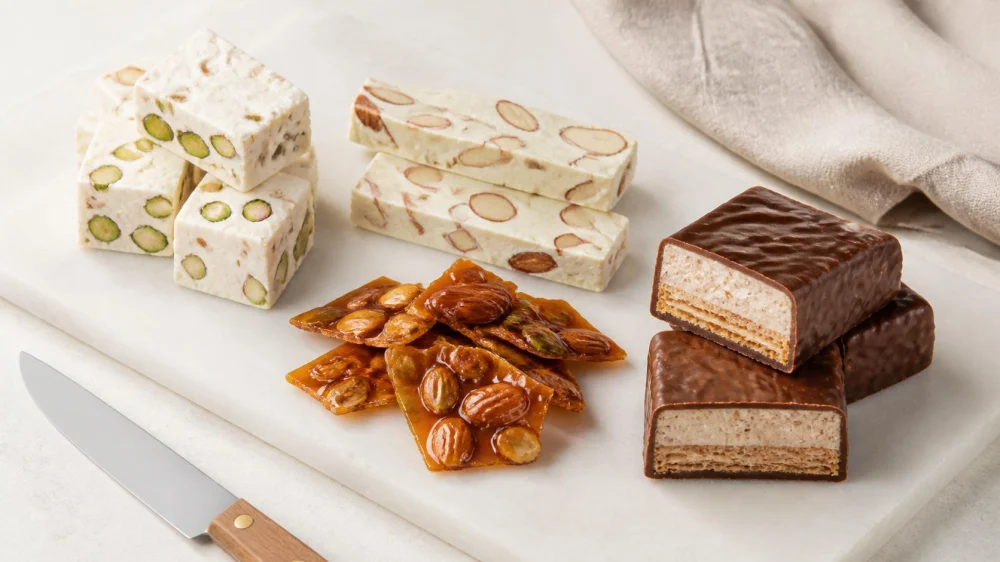
Choose whipped white nougat for an aerated, tender-to-chewy bite; a firmer nut nougat for a longer chew and distinct pieces; brittle-style nougat for crisp caramelized sugar; and layered or chocolate-coated nougat when you want contrast with caramel, wafers, nuts, or chocolate. “Nougat” covers several traditions and commercial styles, so read the texture description and ingredients. Check package condition, nut and egg allergens, portion size, and storage before buying.
This US candy guide describes common menu and retail usage. Recipes differ by country, confectioner, and product. The current package or shop staff should be the source for ingredients, allergens, certifications, shelf life, and storage.

Thomas Chocolate / thomas sweet new brunswick
New BrunswickMiddlesex CountyNew Jersey
57 Easton Ave, New Brunswick, NJ 08901, USA
What nougat means
Nougat is a confection built from cooked sweeteners and a structured matrix that may include whipped egg white, nuts, seeds, dried fruit, wafers, chocolate, or flavoring. The name covers a range from pale and aerated to dark and crisp.
Texture depends on the sugar or syrup stage, moisture, aeration, mixing, cooling, nut ratio, and storage. A candy bar’s “nougat” center can be softer and more uniform than a traditional slab filled with whole nuts.
Do not expect every nougat to look or chew alike. Ask whether it is soft, chewy, firm, brittle, nut-forward, chocolate-coated, or layered.

Goofy's Candy Company / goofy's candy co
1375 E Buena Vista Dr, Orlando, FL 32821, USA
White or whipped nougat
White nougat is generally pale and aerated, often using whipped egg white with cooked honey, sugar, syrup, or combinations. It can range from tender and slightly tacky to dense and sliceable.
Choose it when you want:
- a lighter-looking, aerated structure;
- a honey or vanilla-forward base;
- nuts or fruit suspended throughout; or
- a texture between marshmallow-like softness and firm chew.
Rice paper or wafer sheets may be placed on the top and bottom to make a sticky slab easier to handle. Check the ingredients if wheat, starch source, or other dietary restrictions matter.
Caramelized or brittle-style nougat
Some nougat traditions use caramelized sugar or honey with nuts and little or no aerated white matrix. The result can be darker, glassier, crisp, or brittle rather than soft and whipped.
This style is best for people who prefer roasted nut flavor and a sharp snap. It is not ideal for anyone who needs an easy-to-chew candy. Break it into modest pieces using the maker’s serving guidance rather than biting a thick slab with the front teeth.
“Brown nougat,” “black nougat,” “nut brittle,” and regional product names can overlap without being exact synonyms. Let the ingredient and texture description guide the choice.
Soft, chewy, firm, and crisp textures
- Soft: yields easily, may feel plush, and releases flavor quickly.
- Chewy: offers steady resistance and holds inclusions together.
- Firm: cuts cleanly and requires a deliberate bite.
- Crisp or brittle: snaps before dissolving or becoming chewy.
Temperature changes the experience. A cold chocolate-coated bar may feel harder than the same bar at the package’s recommended serving temperature. Warmth can soften filling, increase stickiness, and blur layers.
Thickness matters too. A thin firm slice can be easier to manage than a tall soft cube. Ask the shop to cut a smaller piece only if its handling policy allows.
Nuts, fruit, seeds, and flavoring
Almonds, pistachios, hazelnuts, peanuts, and other nuts add crunch, roast flavor, and visual contrast. Dried cherries, citrus peel, berries, or apricots can add acidity and chew. Seeds, coffee, cocoa, spices, floral flavors, and extracts may also appear.
Compare:
- inclusion ratio: mostly base or packed with pieces;
- piece size: whole nuts, chopped pieces, or fine meal;
- distribution: evenly mixed or layered;
- roast level: mild, toasted, or deeply caramelized; and
- flavor balance: sweet, bitter, tart, salty, floral, or spiced.
Whole nuts can make a slab harder to cut evenly. Small children and people with chewing or swallowing concerns need an appropriate alternative.
Layered bars and chocolate-coated nougat
Commercial candy bars may pair a nougat-style center with caramel, peanuts, wafers, cookie pieces, or a chocolate coating. The center may be formulated for stability and a uniform bite rather than to resemble an artisan nut slab.
Chocolate changes melt, sweetness, and handling. Caramel adds stretch and stickiness. Wafers add a dry crunch. Nuts add irregular resistance. Evaluate the whole bar as a layered confection, then note which component dominates.
A product name can use “nougat” while the ingredient list uses more specific terms for the center. Read both rather than inferring composition from the front label alone.
Check freshness and storage
Fresh nougat should match the maker’s intended color, aroma, and texture. A soft style can become dry or hard after moisture loss; a crisp style can become sticky in humidity; nuts can develop an unpleasant stale or rancid odor.
Check:
- seal, wrapper, and box integrity;
- best-by guidance and shop rotation;
- unexpected moisture, oil leakage, or bloom on coatings;
- off odor, mold, insects, or foreign material; and
- the product’s temperature and humidity instructions.
Store opened pieces in the packaging or an appropriate airtight container, away from heat, sunlight, humidity, and strong odors. Separate varieties when aromas transfer easily.
Read allergens and dietary labels
Nougat frequently contains or contacts major allergens such as egg, milk, peanuts, tree nuts, wheat, soy, or sesame, depending on the recipe and facility. Honey, gelatin, chocolate, wafers, colors, and flavorings can also affect vegan, vegetarian, halal, kosher, or other dietary preferences.
Read the current ingredient list, “Contains” statement, cross-contact advisory, and certification marks. For unwrapped counter candy, ask staff to consult the product record rather than guessing from appearance.
Recipes and suppliers can change. A different flavor, size, seasonal batch, or coating from the same maker may use different ingredients.
Taste nougat by texture and balance
- Bring comparable pieces to the recommended serving temperature.
- Look at aeration, layers, and inclusion distribution.
- Smell for honey, roast, cocoa, fruit, or spice.
- Take a small bite and note yield, snap, rebound, and stickiness.
- Notice when sweetness, nut, fruit, salt, and coating appear.
- Record the finish: clean, lingering, oily, dry, or aromatic.
- Use water and a pause between strongly flavored samples.
Taste texture and flavor separately. A favorite pistachio flavor may appear in a texture you do not prefer, while a plain nougat can reveal the base structure more clearly.
Frequently asked questions
Is nougat always made with nuts?
No. Nuts are common in many traditional and commercial styles, but some nougat-style centers are smooth or use other inclusions. Check the actual ingredients and allergen statement.
Is nougat the same as marshmallow?
No. Both can be aerated confections, but recipes, cooking, sweeteners, moisture, structure, and intended texture differ. A soft commercial nougat center may remind people of marshmallow without being the same product.
Why is my nougat so hard?
It may be an intentionally firm or brittle style, be cold, or have lost moisture. Check the package description, date, seal, odor, and storage instructions before deciding.
Does white nougat contain egg?
Many recipes use egg white, but not all products do. Read the current label or ask the maker; appearance is not reliable for allergy decisions.
Sources and evidence notes
This article uses common confectionery terminology across artisan nougat, regional nut confections, and commercial candy-bar centers. The category has no single universal texture or formula. Sensory descriptions are therefore presented as comparison language, while ingredients, allergens, dietary claims, dates, and storage must come from the current package, shop record, or manufacturer.
Conclusion and next steps
Start with the texture: whipped and tender, chewy and nutty, firm and sliceable, or crisp and caramelized. Then compare inclusions, layers, coating, thickness, freshness, and ingredient needs. Ask the candy shop for a plain description rather than relying on the word “nougat” alone, and choose a modest piece at the right temperature to experience the intended structure.





 Cruncheelicious, LLC0.0 (0 reviews)
 Mariebelle4.0 (41 reviews)
 Goody Bag & Basket Co4.0 (17 reviews)
 Oh My Chocolate4.0 (133 reviews)
 TAFF Treats4.0 (25 reviews)
 See's Candies4.0 (28 reviews)
 Top Candy Shops for Tourists in New York – Best Sweets and Treats
 Best Candy Shops in New York - A Sweet Adventure Through the City
 How to Make Candy-Themed Crafts for Christmas Gift Giving
 How to Make Chocolate-Covered Strawberries for Kids: A Fun and Easy Recipe
 How to Make Easy Gummy Worms at Home | Homemade Candy Recipes
 How to Host a Candy-Themed Movie Night | Fun and Sweet Ideas