
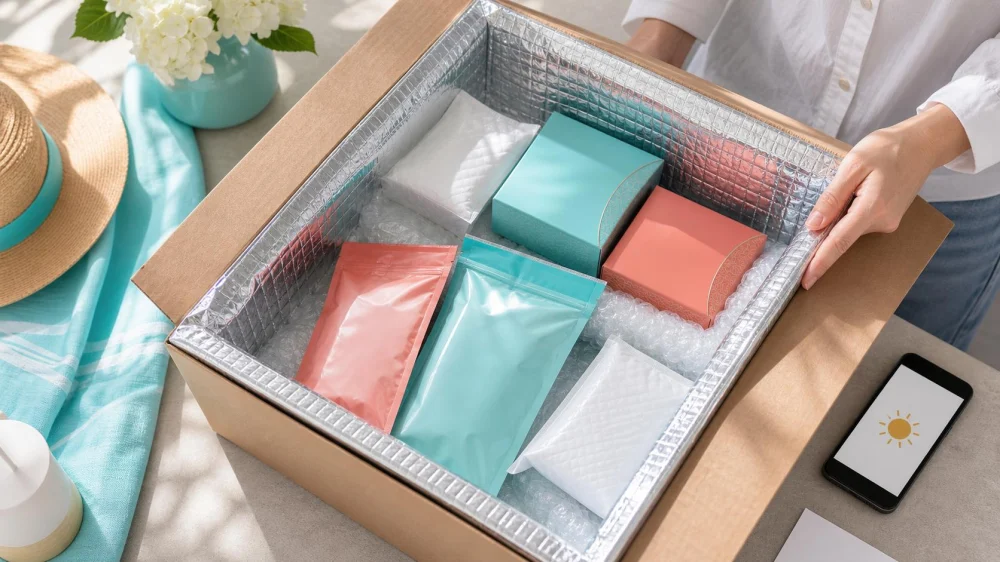
How to Ship Candy in Hot Weather Without Ruining It
On this page
- Quick answer
- Choose candy that tolerates the route
- Plan timing and carrier service
- Build a heat-aware package
- Preserve labels and gift details
- Manage delivery and arrival
- Hot-weather candy shipping checklist
- Limitations and food-safety notes
- Frequently asked questions
- Sources and evidence notes
- Test one package before the event
Quick answer
Check the weather at origin, transit hubs, and destination; choose heat-tolerant candy or buy a temperature-controlled service; ship early in the week with the shortest realistic transit; wrap products against moisture and movement; use insulation and food-safe cold packs according to the candy maker and carrier; and arrange immediate delivery to a person or climate-controlled pickup point. Do not expect a reflective envelope or “fragile” label to protect chocolate left in a hot truck or porch.
For valuable, handmade, filled, or highly perishable candy, ask the producer for exact temperature and shipping instructions.

Chocolate Springs Cafe / chocolate springs lenox massachusetts
LenoxBerkshire CountyMassachusetts
55 Pittsfield Rd, Lenox, MA 01240, USA
Choose candy that tolerates the route
Chocolate, gummies, caramels, marshmallows, hard candy, coated nuts, and filled confections respond differently to heat and humidity. Chocolate may soften or bloom, gummies can stick, hard candy can become tacky, and fillings may have separate storage limits.
Keep the maker's packaging and care information. Consider heat-stable alternatives when the forecast, destination, or delivery access makes the preferred candy impractical. Do not ship a homemade item without knowing its food-safety and storage needs.
Carousel Candies / chocolate carousel nj
Point Pleasant BeachOcean CountyNew Jersey
500 Boardwalk, Point Pleasant Beach, NJ 08742, USA
Plan timing and carrier service
Compare current carrier cutoff times, transit commitments, weekend operations, holiday schedules, insurance terms, and temperature-related exclusions. Ship Monday through Wednesday when possible to reduce weekend holds, but confirm actual service.
Choose morning drop-off close to the carrier's collection rather than leaving the parcel in outdoor heat. Send tracking immediately and require a delivery method the recipient can meet. A faster service reduces exposure time but does not guarantee temperature control.
Build a heat-aware package
Start with candy cooled to the maker's recommended storage condition, not frozen unless instructed. Seal it against condensation and odors. Cushion individual boxes so they do not slide, crush, or contact cold packs directly.
Use an insulated liner sized for the outer box, then add food-safe cold packs with a barrier to distribute cooling and contain condensation. Fill empty space, close seams, and place insulation on all sides. More refrigerant is not automatically better; excessive cold can damage texture or create moisture.
Preserve labels and gift details
Keep ingredient, allergen, lot, best-by, manufacturer, and storage information with each product. Put greeting cards in a moisture-resistant sleeve and avoid perfume, scented packing, or ink that can transfer odor or color.
Label the recipient and return address clearly and place a duplicate address card inside. Follow the carrier's current rules for cold packs and any dry ice; dry ice requires special hazard knowledge, ventilation, marking, and carrier compliance and is not a casual substitute.
Manage delivery and arrival
Ask the recipient to be available, enable delivery alerts, and bring the package indoors immediately. A staffed office, approved pickup location, or held-for-pickup option can be better than an exposed porch.
On arrival, photograph damage before opening, check the product against maker instructions, and inspect for torn packaging, leakage, unexpected odor, contamination, or severe texture change. Contact the seller or carrier promptly under their policy.
Hot-weather candy shipping checklist
- Check weather across the route.
- Choose candy suited to heat and humidity.
- Confirm current transit and weekend timing.
- Use sealed product packaging and full insulation.
- Separate cold packs from candy.
- Preserve ingredients, allergens, and care information.
- Arrange alerts and immediate indoor delivery.
- Document the packed box and arrival condition.
Limitations and food-safety notes
- Insulation slows temperature change; it does not create indefinite refrigeration.
- Carrier networks can face delays, hot vehicles, and outdoor holds.
- Quality changes such as chocolate bloom are different from food-safety determinations.
- Filled, dairy-based, homemade, or specialty products may require stricter controls.
- When packaging is compromised or storage limits are uncertain, ask the maker rather than tasting to test safety.
Frequently asked questions
Will frozen gel packs prevent melting?
They can reduce heat exposure in a well-designed package, but duration, insulation, route, and product matter. Follow maker guidance.
Should chocolate be frozen before shipping?
Usually not without product-specific instructions. Freezing and condensation can affect texture and appearance.
Is overnight shipping required?
Not always, but shorter predictable transit reduces exposure. Compare product needs, forecast, delivery access, and cost.
Can I mark the box “keep cool”?
You can communicate handling needs where permitted, but a label does not guarantee refrigerated handling.
What if the candy arrives soft?
Follow the maker's instructions. Do not judge food safety solely by whether the product rehardens.
Sources and evidence notes
This packaging method applies temperature-control and parcel principles: select a suitable product, minimize transit, seal against moisture, insulate completely, prevent direct refrigerant contact, preserve labels, and arrange prompt receipt. The maker and carrier set product-specific and shipping requirements.
Test one package before the event
Pack a sample using the planned candy, box, insulation, and cold packs, then place it in a warm but safe test environment for the expected transit duration. Evaluate product condition and condensation before shipping gifts at scale.





 The Chocolaterie Luxury Chocolates4.0 (315 reviews)
 Gems Cough Drops5.0 (1 reviews)
 Rocky Mountain Chocolate Factory4.0 (175 reviews)
 The Chocolate Shell4.0 (79 reviews)
 Jack's Candy Store4.0 (14 reviews)
 Dulceria Callie4.0 (20 reviews)
 Top Candy Shops for Tourists in New York – Best Sweets and Treats
 Best Candy Shops in New York - A Sweet Adventure Through the City
 How to Make Candy-Themed Crafts for Christmas Gift Giving
 How to Make Chocolate-Covered Strawberries for Kids: A Fun and Easy Recipe
 How to Make Easy Gummy Worms at Home | Homemade Candy Recipes
 How to Host a Candy-Themed Movie Night | Fun and Sweet Ideas