
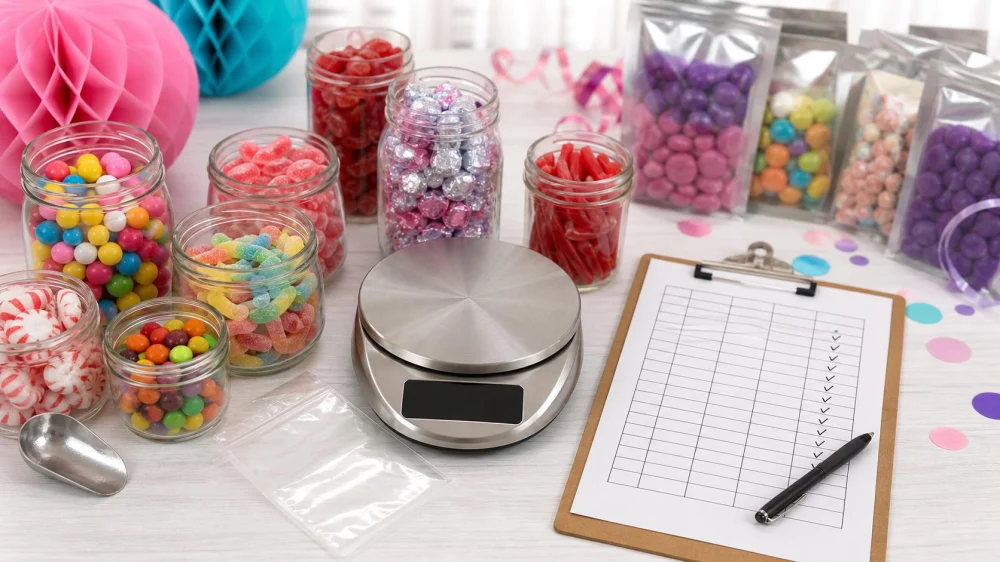
How to Estimate Candy Quantities for a Party Table
On this page
- Quick answer
- Define what the candy table must do
- Build a realistic guest count
- Choose a portion model
- Plan variety without buying too much
- Convert packages into usable servings
- Match quantity to containers and refills
- Manage allergens, age, and food safety
- Plan for leftovers before purchasing
- Frequently asked questions
- Conclusion and planning worksheet
Quick answer
Estimate candy by function, not by one universal per-person number. Decide whether it is a small accent, a self-serve dessert, or a take-home favor. Count the guests likely to eat candy, choose a target portion range, add only a modest buffer, and divide that total among a few popular types. Use package net weights and a kitchen scale to test how much your containers and favor bags actually hold.
Thomas Chocolate / thomas sweet new brunswick
New BrunswickMiddlesex CountyNew Jersey
57 Easton Ave, New Brunswick, NJ 08901, USA
Define what the candy table must do
The same guest count can require very different amounts. Identify the table's role:
- Decorative accent: Candy supports the theme but other desserts are primary.
- Self-serve dessert: Guests fill a small cup or bag during the event.
- Favor station: Each guest takes a defined container home.
- Tasting activity: Small pieces are sampled in a planned sequence.
- Mixed snack table: Candy shares demand with salty snacks, fruit, cake, or drinks.
Write the purpose at the top of the order sheet. It prevents a visually large display from being mistaken for unlimited portions.

Goofy's Candy Company / goofy's candy co
1375 E Buena Vista Dr, Orlando, FL 32821, USA
Build a realistic guest count
Start with confirmed attendees, then consider children, dietary restrictions, event duration, meal timing, other desserts, and whether candy is taken home. Do not assume every invited person consumes the same amount.
Create three lines:
- Expected candy participants: Guests likely to take some.
- Defined favors: One package for each person who must receive one.
- Buffer: A small allowance for spills, late confirmations, and uneven preferences.
For favors, count containers rather than appetite. For open service, use a range and refill in batches instead of displaying the entire supply at once.
Choose a portion model
Use one of three methods:
Container method
Select the actual cup, bag, box, or scoop. Fill it to the intended level with a representative candy, weigh the contents, and multiply by the number of servings. This is the most practical method for favors.
Weight-range method
Set a modest minimum and maximum total weight per participating guest based on the event role. Test the range in a real container so the number has a visible meaning. Avoid copying an online rule without considering other food.
Piece-count method
For individually wrapped or premium pieces, decide how many of each type a person may take. Multiply by expected participants and add a small reserve. Piece counting is unreliable for loose candy with widely different sizes.
Plan variety without buying too much
A few clearly different options often work better than many nearly identical candies. Divide the total into categories such as:
- Chocolate or coated pieces
- Fruity chewy candy
- Hard candy or mints
- Sour option
- One themed color or specialty item
Allocate more to familiar choices and less to polarizing flavors. Do not buy equal weights solely for visual symmetry; a large hard candy and a tiny coated piece create different piece counts and serving behavior.
Keep allergen-free or otherwise special-diet items in original packaging and physically separate. Do not create a mixed scoop bin.
Convert packages into usable servings
- Record each package's net weight.
- Subtract any quantity reserved for favors or replacement.
- Weigh one intended display refill or serving container.
- Calculate how many refills the package provides.
- Round down for breakage, wrappers, and scale variation.
Volume labels on jars do not translate directly to candy weight. Shape, air gaps, wrappers, and density change how much fits. Test with the actual product or a close physical substitute before purchasing bulk quantities.
Match quantity to containers and refills
Large empty-looking jars tempt overbuying. Use smaller vessels, risers, false bottoms designed for food displays, or multiple refill rounds to create height without exposing all inventory.
- Choose stable, food-safe containers with openings wide enough for the scoop.
- Use one utensil per candy and keep handles out of the food.
- Label flavors and major allergens clearly.
- Keep reserve stock sealed in a cool, dry area.
- Refill before a container is empty rather than mixing old crumbs with new stock.
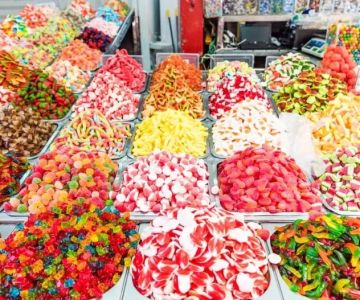
A full table at the opening photograph does not need to contain every purchased piece.
Manage allergens, age, and food safety
Retain original ingredient and allergen labels. Bulk-bin and repackaged candy can lose important traceability. Cross-contact can occur through shared scoops, hands, jars, and refill containers.
Consider choking hazards for young children and any guest with swallowing difficulty. Hard, round, sticky, or very chewy candy may not be appropriate. Ask caregivers and choose an alternative rather than relying on a warning sign alone.
Protect candy from heat, sun, humidity, pests, smoke, and handling. Do not serve candy from damaged, contaminated, melted-and-rehardened, or unidentified packages.
Plan for leftovers before purchasing
Choose products and quantities based on a defined leftover plan:
- Seal unopened packages for later use within their dates.
- Prepare labeled take-home favors before guests leave.
- Donate only unopened acceptable packages to an organization that confirms its policy.
- Avoid saving exposed self-serve candy when contamination is possible.
- Store retained candy according to its package instructions.
A smaller display with controlled refills generally leaves more sealed product than one oversized open table.
Frequently asked questions
How much candy should I buy per person?
There is no universal amount. Define the table's role, test the actual serving container, and adjust for other food, guest mix, and take-home plans.
How many candy varieties are enough?
Several distinct choices usually create better variety than many similar options. The right count depends on guest number, budget, allergens, and display size.
Should jars be filled completely?
No. Smaller jars, planned refills, and safe display risers can create a full look with less exposed candy.
Can I combine packages with the same flavor?
Only when ingredients, allergens, dates, and product identity are truly the same and traceability is retained. Do not mix unknown bulk items.
What should I do with open leftovers?
Consider exposure time, handling, contamination, temperature, and package guidance. When safety is uncertain, discard rather than redistribute.
Conclusion and planning worksheet
Write down the event role, expected participants, actual serving container, target fill weight, variety split, buffer, display capacity, allergen plan, and leftover plan. Weigh a sample instead of guessing from jar size. Buying to a measured service plan produces a better-looking table with less waste and fewer last-minute shortages.



 Cousin's Candy Shops4.0 (241 reviews)
 Russell Stover Chocolates4.0 (901 reviews)
 Krause's Chocolates of New Paltz4.0 (151 reviews)
 Harbor Sweets Copley5.0 (1 reviews)
 Dulceria La Colmena4.0 (32 reviews)
 Sugarpop Candy Bar2.0 (24 reviews)
 Top Candy Shops for Tourists in New York – Best Sweets and Treats
 Best Candy Shops in New York - A Sweet Adventure Through the City
 How to Make Candy-Themed Crafts for Christmas Gift Giving
 How to Make Chocolate-Covered Strawberries for Kids: A Fun and Easy Recipe
 How to Make Easy Gummy Worms at Home | Homemade Candy Recipes
 How to Host a Candy-Themed Movie Night | Fun and Sweet Ideas