
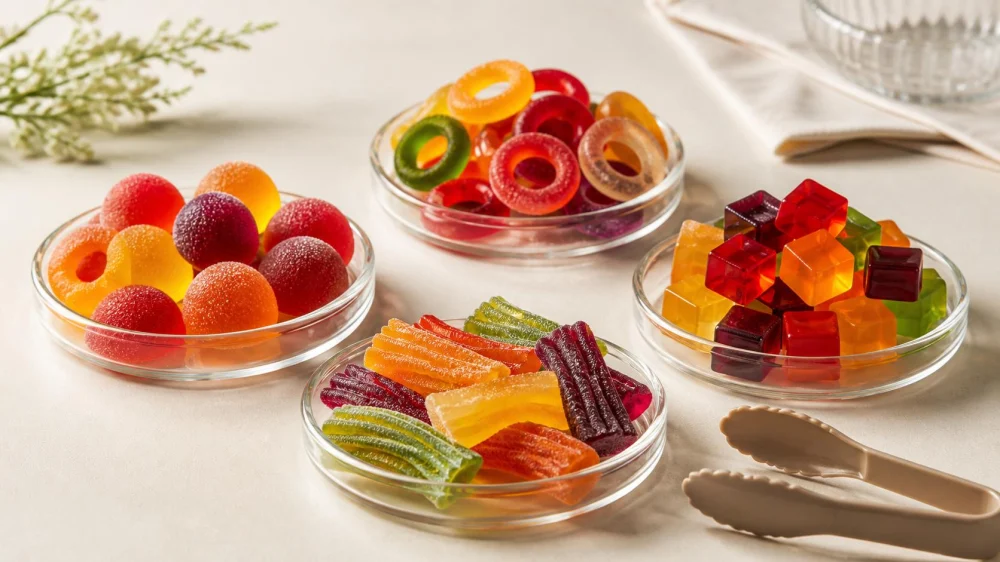
Gummy Candy Texture: Soft, Springy, Chewy, or Firm?
On this page
- Quick answer
- Use four texture words
- Check the gelling ingredient
- Notice shape, size, and surface
- Compare sugar, sour, oil, and wax coatings
- Filled, foamed, and layered gummies
- Separate style from freshness
- Read ingredients and dietary labels
- Run a useful texture tasting
- Gummy-selection checklist
- Frequently asked questions
- Sources and evidence notes
- Conclusion and next steps
Quick answer
Choose soft gummies for an easy bite and quick flavor release, springy gummies for a clean bounce, chewy gummies for longer resistance, and firm gummies for a dense bite that holds its shape. Then compare the gelling ingredient, size, thickness, filling, and surface coating. Pectin, gelatin, starches, and other systems can produce different textures, but the label cannot predict everything. Check package integrity, best-by guidance, allergens, and storage before judging quality.
This US candy guide describes common sensory tendencies, not guaranteed formulas. Texture varies by recipe, concentration, manufacturing process, age, temperature, and storage. Always use the actual package for ingredients, allergens, dietary claims, and handling instructions.

Thomas Chocolate / thomas sweet new brunswick
New BrunswickMiddlesex CountyNew Jersey
57 Easton Ave, New Brunswick, NJ 08901, USA
Use four texture words
Gummy texture is the way a candy deforms, breaks, sticks, and recovers while you bite and chew it. “Good” is personal; more precise words help you compare products.
- Soft: yields easily with little jaw pressure and may feel tender or plush.
- Springy: compresses and rebounds, often giving a clean, elastic bite.
- Chewy: resists for several bites and extends flavor release.
- Firm: feels dense, holds edges, and requires a more deliberate bite.
A gummy can be both soft and sticky, springy and firm, or chewy without much bounce. Add secondary terms such as juicy, tacky, smooth, grainy, foamy, crisp-coated, or dissolving.

The Ganachery / the ganachery
Lake Buena VistaOrange CountyFlorida
1486 East Buena Vista Drive, Disney Springs, Town Center, Lake Buena Vista, FL 32830, USA
Check the gelling ingredient
The gelling system helps create structure, but it works with sugar, syrup, acid, water, flavor, and the production process. Common labels may list:
- gelatin: often associated with an elastic, springy chew;
- pectin: often used for a cleaner, shorter bite in fruit-style gummies;
- starch or modified starch: can build body or participate in the molding process;
- agar, carrageenan, or other hydrocolloids: may appear in plant-based or specialized formulations; and
- combinations: can balance bounce, firmness, heat stability, and release.
These are tendencies, not a ranking. Two gelatin gummies can feel very different, and a pectin gummy can be formulated soft or firm. The order and exact quantities are not fully shown by a standard ingredient list.
Notice shape, size, and surface
Shape changes the bite even when the recipe is identical. A thin ribbon bends and stretches; a thick cube feels denser; a small bear offers several narrow edges; a large ring lets you bite sections. Hollow or ridged shapes can compress differently from solid smooth pieces.
Compare thickness before assuming one bag contains a harder formula. Let pieces reach the same room temperature and sample similar sizes. A cold gummy will often feel firmer than the same product in a warm room.
Surface area also changes flavor impact. Small pieces or ridges carry more coating relative to the center, while a large smooth piece emphasizes the gel itself.
Compare sugar, sour, oil, and wax coatings
A fine sugar coating adds dry crystals and an immediate sweet crunch. A sour sanding can produce a sharp first impression before the gummy center appears. Crystal size and coverage influence how grainy or crisp the surface feels.
Oil or wax finishing can reduce surface sticking and create shine. A matte gummy may feel drier, while an uncoated product can feel tackier. Coating does not reveal freshness by itself; it may be an intentional style.
Read the ingredient list for acids, sugars, oils, waxes, colors, and flavoring. Do not assume a sour surface uses the same ingredients as a sour center.
Filled, foamed, and layered gummies
Filled gummies pair an outer gel with a liquid, syrupy, or softer center. Bite gently because pressure can push filling out. The contrast may deliver flavor quickly even when the shell is chewy.
Foamed gummies include a more aerated, opaque layer that can feel lighter or marshmallow-like. Layered pieces can combine two gel textures, a foam base, or different flavors. Evaluate each layer separately before describing the whole candy.
For children or anyone with chewing or swallowing difficulty, shape and filling can change handling risk. Choose age- and ability-appropriate foods and follow professional guidance when needed.
Separate style from freshness
Some gummies are designed to be dense, dry-surfaced, or highly resistant. A firm bite is not automatically stale. Instead, compare the product with its package description and normal appearance.
Check for:
- an unsealed, torn, punctured, or swollen package;
- moisture, leaking filling, or unexpected clumping;
- unusual odor, color, mold, or foreign material;
- extreme hardening or melting inconsistent with the style; and
- storage outside the label’s directions.
Do not taste candy with damaged packaging or signs of spoilage. Return or discard it according to retailer and local guidance.
Read ingredients and dietary labels
A color, shape, or “fruit” name does not prove that a gummy is vegan, vegetarian, halal, kosher, allergen-free, gluten-free, or made with a particular fruit. Gelatin source, processing aids, colors, flavors, coatings, and shared equipment may matter.
Read the ingredient list, “Contains” statement, cross-contact advisory, certification mark, and manufacturer contact on the current package. Formulas can change, so do not rely on an old online photo or another flavor from the same brand.
For a serious food allergy, contact the manufacturer when the label does not answer the question and follow the individual’s medical plan. “Plant-based” does not mean free from the major allergens.
Run a useful texture tasting
- Choose three or four sealed products with distinct descriptions.
- Bring them to the same comfortable room temperature.
- Use similar-sized pieces and keep the packages for reference.
- Look at surface, thickness, and layers before biting.
- Record first bite, rebound, chew length, stickiness, and finish.
- Cleanse the palate with water and take a break between strong sour coatings.
- Rank each texture separately from flavor.
Serve modest portions and avoid games that encourage rapid eating, overfilling the mouth, or guessing an allergen-containing product.
Gummy-selection checklist
- Desired texture: soft, springy, chewy, or firm
- Gelling ingredients and dietary fit checked
- Shape, thickness, layers, and filling considered
- Sugar, sour, oil, wax, or no coating compared
- Package sealed and undamaged
- Best-by and storage instructions reviewed
- Ingredients and allergens read on the current package
- Piece size appropriate for the eater
- Strong flavors stored separately after opening
Frequently asked questions
Are pectin gummies always softer than gelatin gummies?
No. Recipe, concentration, moisture, acid, process, size, and storage all influence texture. Pectin and gelatin have common tendencies, but either can be formulated across a range.
Why did my gummies become hard?
Moisture loss, cold temperature, age, or an unsealed package can increase firmness. Check the product’s intended style, package condition, date, and storage directions before deciding.
Why are sour gummies wet or sticky?
Temperature, humidity, acid-sugar coating, and moisture movement can affect the surface. Do not eat pieces with damaged packaging, unusual odor, mold, or other spoilage signs.
Does gelatin-free mean vegan?
Not automatically. Other ingredients, colors, flavors, coatings, or processing may be animal-derived. Look for a clear current claim or certification and contact the manufacturer if needed.
Sources and evidence notes
This guide uses common confectionery and sensory terminology. Gelling ingredients influence structure through complex interactions with sweeteners, acids, water, process, temperature, and storage, so no single ingredient predicts the complete texture. Ingredient, allergen, certification, date, and handling information should come from the current package or manufacturer rather than from appearance.
Conclusion and next steps
Choose gummy candy by naming the texture you want, then compare the gelling system, shape, thickness, surface, filling, and storage condition. Use soft, springy, chewy, and firm as starting points, not value judgments. Keep the package, check ingredients and dietary claims, and taste similar-sized pieces at the same temperature to discover which texture actually fits your preference.



 Cruncheelicious, LLC0.0 (0 reviews)
 Mariebelle4.0 (41 reviews)
 Goody Bag & Basket Co4.0 (17 reviews)
 Oh My Chocolate4.0 (133 reviews)
 TAFF Treats4.0 (25 reviews)
 See's Candies4.0 (28 reviews)
 Top Candy Shops for Tourists in New York – Best Sweets and Treats
 Best Candy Shops in New York - A Sweet Adventure Through the City
 How to Make Candy-Themed Crafts for Christmas Gift Giving
 How to Make Chocolate-Covered Strawberries for Kids: A Fun and Easy Recipe
 How to Make Easy Gummy Worms at Home | Homemade Candy Recipes
 How to Host a Candy-Themed Movie Night | Fun and Sweet Ideas