
Caramel Candy Guide: Soft, Chewy, Filled, and Stored
On this page
Quick answer
Choose caramel candy by texture, dairy richness, salt, coating, filling, and how it will be stored. Soft caramels yield quickly; chewy caramels hold their shape; hard caramelized candies dissolve rather than bend; filled chocolates may contain a flowing caramel center. Read every label for milk, nuts, soy, wheat, and other allergens, and avoid very sticky candy when dental work or chewing safety is a concern.
Store each product by its package instructions. Heat can make wrapped caramels merge, while cold can make them unexpectedly firm.

Mister Ed's Elephant Museum & Candy Emporium / mister ed's elephant museum & candy emporium
OrrtannaAdams CountyPennsylvania
6019 Chambersburg Rd, Orrtanna, PA 17353, USA
Know the caramel styles
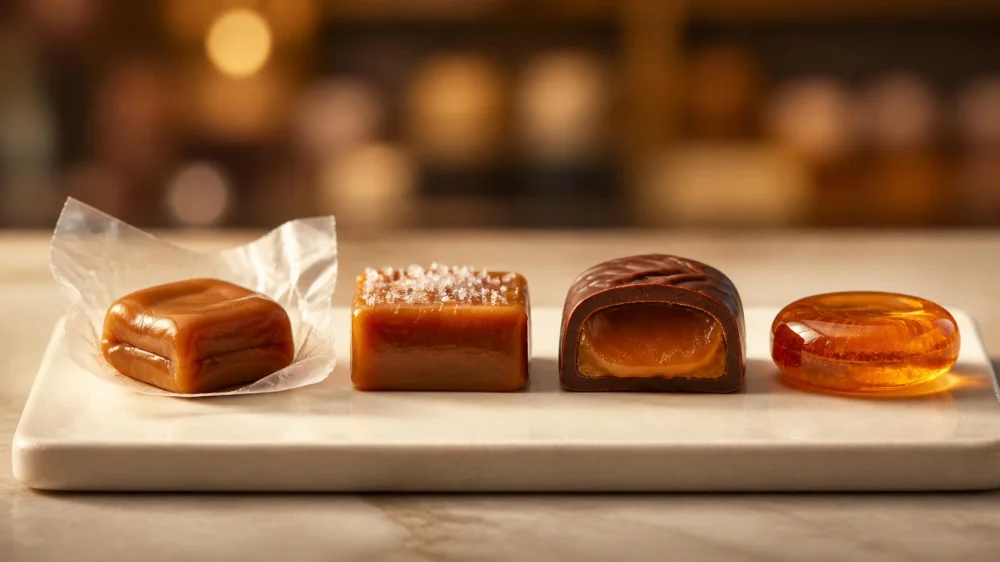
- Soft wrapped caramel: tender bite, often made with dairy and individually wrapped.
- Chewy caramel: more pull and longer chew.
- Salted caramel: sweetness balanced with salt, sometimes with visible crystals.
- Caramel-filled chocolate: shell plus soft, chewy, or liquid center.
- Caramel-coated candy: nuts, popcorn, fruit, or another center with a caramel layer.
- Hard caramel candy: glassy texture intended to dissolve slowly.
Names do not standardize firmness. Ask the shop whether the product is soft, sticky, flowing, or hard at room temperature.

Chocolate Museum & Cafe / chocolate museum and cafe
11701 International Dr #400, Orlando, FL 32821, USA
Choose the texture
Temperature strongly changes caramel. Warm soft caramel can stretch and stick; cool caramel can become dense and difficult to bite. Let packaged candy reach the maker’s recommended serving condition rather than microwaving it.
For older adults, young children, or anyone with chewing or swallowing concerns, choose an appropriate texture and supervise as needed. Hard and very chewy candy can create choking or dental risks.
Flavor and fillings
Vanilla, browned butter, sea salt, coffee, chocolate, fruit, spice, and spirits can deepen caramel. Nuts add crunch and bitterness. A small salt accent can sharpen flavor, but heavily salted candy may overwhelm delicate fillings.
For a mixed box, choose a plain caramel as a baseline, one chocolate-coated piece, one nut or coffee style, and one fruit or spice variation. Keep very aromatic flavors individually wrapped.
Ingredients and allergens
Caramels commonly contain milk, butter, cream, soy, nuts, peanuts, wheat, egg, or sesame through the candy, coatings, inclusions, and shared equipment. Vegan-looking dark caramel or a fruit flavor does not prove dairy-free status.
Read the current package every time and ask staff about unpackaged items, shared tools, display trays, and production. Do not rely on color, flavor name, or removal of a nut garnish.
Eat with care
- Check the wrapper is intact and the candy looks and smells normal.
- Remove every piece of paper, film, or twist wrap.
- Take a small bite rather than forcing a large cold caramel.
- Let hard candy dissolve; do not crunch it against teeth.
- Keep sticky candy away from braces, loose crowns, dentures, and other dental work unless a dentist says it is suitable.
- Supervise children and keep candy away from pets.
If a candy pulls out dental work, stop eating, save the dental piece if available, and contact a dentist.
Storage and gifting
Keep caramels closed in their original packaging at the temperature and humidity the maker specifies. Separate pieces with their wrappers or liners so they do not fuse. Protect chocolate-coated or filled items from heat and temperature cycling.
For a gift, include the ingredient label, best-by date, storage instructions, and any refrigeration guidance. Do not combine unwrapped varieties when allergens or strong flavors differ.
Frequently asked questions
Why did caramels become hard?
Cold temperature, moisture loss, age, or the recipe may contribute. Follow package guidance and do not microwave a wrapped piece.
Can I refrigerate caramel candy?
Only if the maker recommends it; refrigeration can change texture and cause condensation.
Is salted caramel dairy-free?
Not necessarily. Most traditional caramels contain dairy, and formulas vary.
Can pets eat caramel?
Keep candy away from pets. Ingredients such as chocolate, xylitol, raisins, or certain nuts can be dangerous.
Why is filling leaking?
Heat, shell damage, or age may be involved. Check packaging and storage instructions and discard damaged or questionable pieces.
Sources and evidence notes
This guide uses sugar texture, temperature, packaging, dental-caution, choking-prevention, and food-allergy principles. Ingredients, water activity, shelf life, storage, and serving texture vary by recipe and maker.
Use the current package and candy-maker guidance, plus dental or medical advice for individual chewing and swallowing concerns.
Conclusion and next steps
Decide whether you want soft, chewy, flowing, or hard caramel, then compare coatings and fillings. Read the complete label, let the candy reach its recommended texture, and take small bites without forcing sticky candy against dental work. Keep pieces wrapped, cool, dry, and labeled so the final caramel is as distinct as the first.




 See's Candies4.0 (46 reviews)
 Ricky's Chocolate Box4.0 (231 reviews)
 MMELO Boutique Confections4.0 (104 reviews)
 Fannie May4.0 (156 reviews)
 Bobb Howard's General Store & Auto Repair4.0 (247 reviews)
 Sweet Street Candies and Goodies4.0 (66 reviews)
 Top Candy Shops for Tourists in New York – Best Sweets and Treats
 Best Candy Shops in New York - A Sweet Adventure Through the City
 How to Make Candy-Themed Crafts for Christmas Gift Giving
 How to Make Chocolate-Covered Strawberries for Kids: A Fun and Easy Recipe
 How to Make Easy Gummy Worms at Home | Homemade Candy Recipes
 How to Host a Candy-Themed Movie Night | Fun and Sweet Ideas