
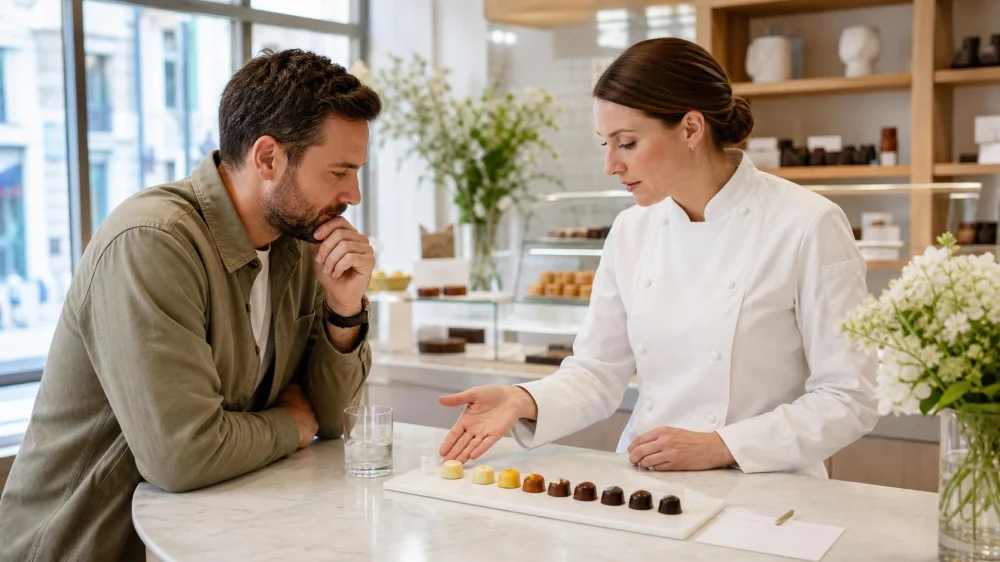
Candy Store Tasting Flight: Compare Flavor, Texture, and Finish
On this page
Quick answer
Build a candy tasting flight around one comparison—such as cocoa intensity, fruit profile, caramelisation, texture, or coating—and keep portions small. Check ingredients and allergen information first, then taste from delicate to intense with water between samples. Record appearance, aroma, first texture, flavour change, sweetness, acidity, bitterness, salt, and finish without trying to name every ingredient.
Droolin Moose / droolin moose
St. Louis ParkHennepin CountyMinnesota
5007 Excelsior Blvd, St Louis Park, MN 55416, USA
Choose a clear theme
A tasting flight becomes easier to understand when only a few variables change. Comparing ten unrelated candies can be fun, but it teaches less than a focused set. Ask the confectioner for several examples connected by base, process, origin, texture, or flavour family.
Possible themes include milk-to-dark chocolate, soft-to-firm caramel, citrus varieties, nut pralines, fruit jellies, mint styles, coffee intensity, single texture with different coatings, or one flavour across several formats. Keep the flight small enough to notice differences before sweetness and fatigue blur them.
Confirm the product names, ingredients, allergens, alcohol, caffeine, dietary restrictions, and cross-contact information before tasting. Never use a flight to test a suspected allergy or intolerance.

Arway Confections / arway confections chicago il
3323 W Newport Ave, Chicago, IL 60618, USA
Set a useful tasting order
Start with samples expected to be delicate, lightly aromatic, or lower in bitterness and finish with strong spice, mint, coffee, dark cocoa, smoke, or intense sourness. A shop's recommended order may differ because texture, filling temperature, or a narrative matters.
Place each sample in sequence before starting. Cut large pieces with the store's guidance so every participant receives the intended layers. Do not divide a filled candy in a way that leaves one person with shell and another with filling.
Use room-temperature water and a plain neutral bite if the shop recommends one. Strong coffee, perfume, gum, flavoured lip products, and back-to-back spicy food can mask subtle aromas.
Observe without rushing
Look at shape, surface, colour, coating, cut, and layers. Smell briefly before biting. Notice whether the first texture is crisp, smooth, powdery, creamy, chewy, sticky, aerated, sandy, brittle, or melting.
Then follow the flavour over time. Ask what appears first, what develops in the middle, and what remains after swallowing. Sweetness is only one dimension; look for acidity, bitterness, salt, roast, fruit, dairy, spice, floral notes, nuts, and caramelisation.
Pause between samples. A flight is not a speed test. If one candy dominates the palate, drink water and wait rather than increasing portion size.
Make notes you can use
Use a simple row for each candy: name or position, aroma, texture, first flavour, developing flavour, finish, and personal response. Separate description from preference. “Firm chew with toasted finish” is more useful than “bad,” while “I prefer a softer chew” helps guide a future purchase.
Rate only attributes that serve the comparison. An overall score can hide why a candy worked. At the end, revisit notes rather than immediately retasting everything.
Ask the confectioner about storage, best serving temperature, and how long the assortment is intended to keep. Buy favourites in quantities you can store as directed.
Tasting checklist
- One focused comparison selected.
- Ingredients, allergens, alcohol, and caffeine checked.
- Small complete portions prepared.
- Delicate-to-intense order confirmed.
- Water and neutral palate break available.
- Aroma, texture, flavour change, and finish observed.
- Description separated from preference.
- Storage and serving guidance collected.
Limitations and food notes
This article is a sensory guide, not medical, allergy, nutrition, or food-safety advice. Product ingredients, cross-contact, alcohol, caffeine, sweeteners, storage, and freshness differ. Use current shop or package information and qualified healthcare guidance for dietary risk. Supervise children and anyone with chewing or choking concerns using age- and ability-appropriate foods.
FAQ
How many candies belong in a flight?
There is no fixed number. Choose enough to show the theme without overwhelming attention or appetite.
Should chocolate always come last?
Not always. Intensity, filling, aroma, and the shop's intended sequence matter more than one universal rule.
Can people share one piece?
Only if it can be divided hygienically while preserving the intended layers and portion.
Do I need a scoring scale?
No. Short descriptions of texture, flavour change, finish, and preference are often more useful.
Evidence notes
This guide uses standard comparative-tasting controls: a focused variable, ordered intensity, small portions, neutral palate breaks, staged sensory observation, and descriptive notes separated from preference. It does not claim a universal candy vocabulary or ranking.
Next steps
Ask a local candy shop to build a four-to-six-piece flight around one question, such as “How does caramel texture change?” Photograph the order, keep the tasting card simple, and buy only the favourites you can store correctly.


 Mindy's Munchies0.0 (0 reviews)
 Linden exotics5.0 (2 reviews)
 Candyman On Main4.0 (180 reviews)
 Choconjoy5.0 (4 reviews)
 Rocky Mountain Chocolate Factory4.0 (126 reviews)
 Van Holten's Sweet Shop4.0 (76 reviews)
 Top Candy Shops for Tourists in New York – Best Sweets and Treats
 Best Candy Shops in New York - A Sweet Adventure Through the City
 How to Make Candy-Themed Crafts for Christmas Gift Giving
 How to Make Chocolate-Covered Strawberries for Kids: A Fun and Easy Recipe
 How to Make Easy Gummy Worms at Home | Homemade Candy Recipes
 How to Host a Candy-Themed Movie Night | Fun and Sweet Ideas