
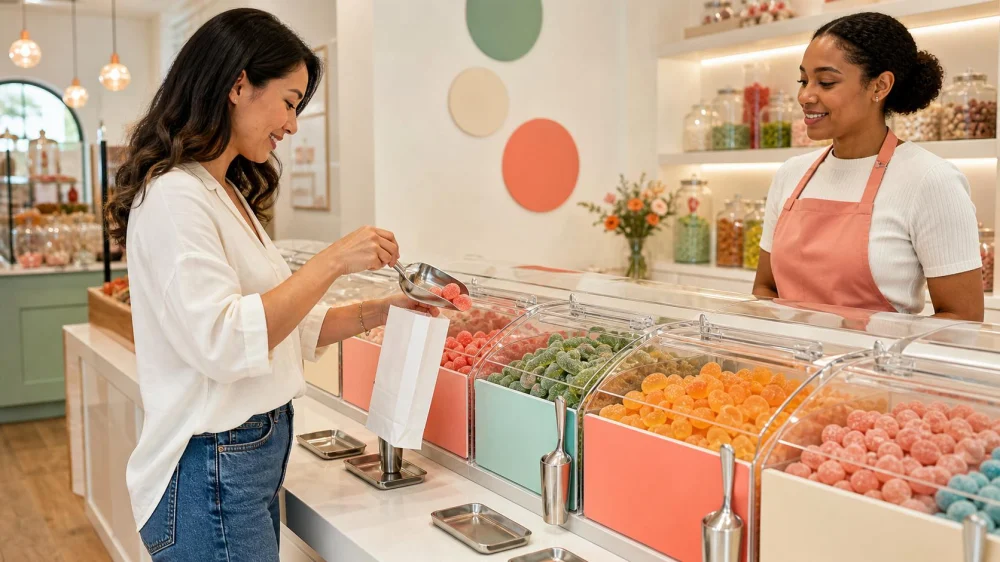
Bulk Candy Bin Checklist: Scoops, Labels, and Clean Bags
On this page
- Quick answer
- Look at the display before opening it
- Use the scoop without touching food
- Start with a clean bag
- Read the product and allergen information
- Understand cross-contact limits
- Do not mix bins or return candy
- Supervise children at the counter
- Check quality without sampling
- Confirm price and weight rules
- Handle bulk candy after purchase
- Report a problem clearly
- Food-safety limits
- Counter checklist
- Frequently asked questions
- Evidence and sources
- Next steps
Quick answer
Choose a bulk candy display with protected bins, clear product information, clean dispensing utensils, and intact bags. Keep hands out of the food, hold the scoop by its handle, use one scoop for its assigned bin, and place the utensil back in the store’s designated protected position.
Do not sample from a self-service bin, return candy, move a scoop between products, or rely on appearance for allergen safety. Ask an employee for current ingredient and major-allergen information and for help when a utensil, label, lid, or bin looks compromised.

Escazu Chocolates / escazu chocolates
RaleighWake CountyNorth Carolina
2409 Crabtree Blvd Suite 124, Raleigh, NC 27604, USA
Look at the display before opening it
A good self-service display protects food from customer contact and environmental contamination. The FDA Food Code is a model that state and local jurisdictions use for retail rules; it calls for ready-to-eat self-service food to have suitable utensils or effective dispensing methods and for displayed food to be protected.
Check for:
- a lid, gravity dispenser, guard, or enclosed case;
- a dedicated scoop, tongs, or dispensing lever;
- a handle that remains above or outside the candy;
- a bin that closes and has no visible crack;
- a clean area for storing the utensil between uses;
- product identity, price basis, and ingredient or allergen access;
- no loose personal items, wrappers, or spilled candy inside.
If a child’s hand, dropped utensil, cough, spill, or foreign object may have contaminated the food, stop using the bin and tell staff. Do not remove only the top layer yourself.

Neuhaus Chocolates / neuhaus nyc
New YorkNew York CountyNew York
488 Madison Ave Between 51st, new location, E 52nd St, New York, NY 10022, USA
Use the scoop without touching food
Wash or sanitize hands before shopping, but remember that clean hands still should not touch ready-to-eat candy. Pick up the scoop by the handle and keep fingers away from the food-contact area.
Use the scoop assigned to that bin. Dispense candy into the open bag without letting the scoop touch your phone, clothing, hair, face, cart, counter edge, or the inside of another bin.
Return the utensil exactly where the store provides. FDA Food Code provisions describe protected storage for in-use utensils and keeping handles above food. Do not bury the handle or balance the scoop on candy.
If the scoop falls on the floor or touches an unclean surface, hand it to an employee. Do not wipe it on clothing or return it.
Start with a clean bag
Use a new store-provided food bag or container. Open it by touching only the outside and rim area. Do not blow into the bag or place it on the floor.
Hold the bag below the dispenser without pushing its outer surface into the candy. Leave enough room to close it securely. Use the supplied tie, seal, or label.
Do not reuse a bag that held a different candy, especially when allergens differ. A visually clean bag can retain crumbs, oils, powders, or flavors.
If you bring a reusable container, ask whether the store allows it and how tare weight and sanitation are handled. Do not place an unapproved container on or inside the display.
Read the product and allergen information
Bulk candy may be sold from original cases or transferred into retail bins. Ask where the current manufacturer ingredient statement and major-allergen declaration can be reviewed. A bin name or flavor card is not a complete label.
Confirm the exact product because similar shapes and colors can have different fillings, glazes, gelatin, nuts, milk, wheat, soy, sesame, or processing statements. Recipes and suppliers can change.
The 2022 FDA Food Code added attention to written notification of major allergens for bulk food available for consumer self-dispensing. Actual local adoption varies, so ask staff how the establishment provides that information.
Keep the product label or photograph the store-provided information for gifts and shared bowls. Do not rewrite “may contain” or facility statements into stronger claims.
Understand cross-contact limits
Adjacent bins, shared counters, dropped candy, customers, and misplaced utensils can create cross-contact. A clean-looking scoop and separate label do not prove an allergy-safe environment.
If you or a recipient has a food allergy, tell staff the exact allergen and ask about supplier packaging, bin cleaning, refill method, scoop control, and cross-contact procedures. When the information is uncertain, sealed manufacturer packaging may be a safer choice.
Do not reach into a bin to retrieve a misplaced candy. Report it. Avoid creating a “nut-free mix” from neighboring bulk bins unless the store can support the claim.
For severe allergy risk, follow the individual’s clinician-directed emergency plan and carry prescribed medication. A candy-store conversation cannot replace medical guidance.
Do not mix bins or return candy
Once candy enters your bag, do not pour it back. The product may have touched your hands, another candy, or an unclean surface. Ask an employee what to do if you dispensed too much.
Do not make a mixed bag when products have different per-pound prices unless the store expressly allows it and provides a method. Separate bags protect pricing, ingredient records, and texture.
If a piece falls on the floor, leave it in place only long enough to alert staff and prevent someone from slipping. Do not put it back or eat it.
Supervise children at the counter
An adult should control the bag and utensil until a child can follow the store’s procedure consistently. Keep small children out of reach of open bins and loose candy.
Bulk candy can create choking and allergy risks. Do not give candy at the counter to occupy a child. Choose age- and development-appropriate food with caregiver supervision, and avoid hard, round, sticky, gummy, or chewy candies for young children as advised by health authorities.
After shopping, wash hands before eating. Do not let a child carry an unsealed bag through the store.
Check quality without sampling
Use sight and the store’s information. Look for clumping, melting, bloom, broken coatings, excessive powder, moisture, insects, foreign objects, or mixed product. These signs may reflect quality, storage, or contamination concerns.
Do not open the lid to smell closely, squeeze pieces, or taste a sample unless staff provides one through an approved service method. A stale texture is not usually visible, so buy a small legal quantity when trying a new product.
Ask when the bin was filled and how stock is rotated. Staff, not customers, should decide whether food is removed.
Confirm price and weight rules
Check whether the posted price is per pound, ounce, 100 grams, container, or piece. Use the correct product code. When mixed bags are allowed, ask which price applies.
Do not place candy directly on a scale unless the store’s system is designed for it. Use the provided bag and tare procedure. Keep the receipt until product identity and price are confirmed.
If the register price differs from the display, ask staff to verify the sign and code rather than switching labels.
Handle bulk candy after purchase
Close the bag, keep it shaded and dry, and avoid a hot vehicle. At home, transfer candy only into a clean, dry, food-safe container if needed. Preserve the product name, ingredient information, purchase date, and store.
Keep different products separate when allergens, flavors, or textures matter. Store out of reach of children and pets. Use clean utensils for serving.
Discard candy exposed to pests, moisture, chemicals, broken glass, or unknown contamination. Contact the store about a recall or quality concern.
Report a problem clearly
Tell an employee the exact bin and issue: “The scoop handle is buried,” “The lid is cracked,” or “A piece from the nut bin fell into this bin.” Avoid quietly rearranging the display.
For suspected illness or a serious allergic reaction, seek medical care and follow local reporting guidance. Save the receipt, remaining product, bag, and label information when safe to do so.
Food-safety limits
This article is general consumer guidance. The FDA Food Code is a model, and state, local, tribal, and territorial jurisdictions adopt and enforce retail requirements differently.
Store employees and regulators control food removal, cleaning, labeling, and inspection. Customers should not attempt to sanitize bins or decide that a contaminated product remains safe.
Counter checklist
- Protected bin or dispenser
- Dedicated clean utensil with handle outside food
- New clean bag or approved container
- Current product, ingredient, and allergen information
- No sampling, hand contact, mixing, or returns
- Adult supervision for children
- Correct price basis and product code
- Staff notified of spills or contamination
Frequently asked questions
Can I taste one piece before buying?
Not from a self-service bin unless the store provides an approved sampling method. Taking a piece can contaminate food and counts as unpurchased product.
Can I combine candies in one bag?
Only if the store permits it and pricing and allergen information remain clear. Separate bags are usually easier to track.
Is a separate scoop enough for food allergies?
No. Supplier, refill, cleaning, customer behavior, and adjacent bins can all contribute to cross-contact.
What if the scoop is inside the candy?
Stop using the bin and tell an employee. Do not reach in to reposition it.
Evidence and sources
- FDA: Food Code and retail adoption information
- FDA: 2022 Food Code changes for bulk allergen information
Next steps
At the next bulk candy counter, pause before touching the scoop. Check the lid, utensil, label, allergen access, bag, and price, then dispense one product at a time.
If any control looks uncertain, ask staff or choose sealed manufacturer packaging.






 Manzanitas Las Originales4.0 (12 reviews)
 Sweeties Candy of Arizona4.0 (608 reviews)
 Nibbles And Nuts3.0 (20 reviews)
 The Fudge Shoppe4.0 (15 reviews)
 Rocky Mountain Chocolate Factory3.0 (59 reviews)
 Anthony-Thomas Candy Shoppe4.0 (72 reviews)
 Top Candy Shops for Tourists in New York – Best Sweets and Treats
 Best Candy Shops in New York - A Sweet Adventure Through the City
 How to Make Candy-Themed Crafts for Christmas Gift Giving
 How to Make Chocolate-Covered Strawberries for Kids: A Fun and Easy Recipe
 How to Make Easy Gummy Worms at Home | Homemade Candy Recipes
 How to Host a Candy-Themed Movie Night | Fun and Sweet Ideas